News for immediate release January 14, 2008
Tri-County Powerboat Alliance Wine & Beer Tasting Fundraiser
Saturday, February 9th, from 7 PM till 9:30 PM join the Tri-County Powerboat Alliance at it’s 7th annual "Wine and Beer Tasting Fundraiser" The event is held at Ted’s Grandview Supper Club, Wolf River Drive, Fremont, Wisconsin, and will feature wonderful wines and beers along with appetizers, music and silent auction items of signed artist prints, Packer memorabilia and raffling of a wine refrigerator.
Cost is just $30 a couple or $20 for an individual, and proceeds go to making our waterways a safe place for all recreational use. Contact TCPA@centurytel.net or 920 446-3930 for more information. No reservations needed, tickets at the door, "Designated Driver" program with free non-alcohol refreshments for drivers.
If you are boating on the Wolf River this season and having a safe and successful fun-filled day, chances are you have the volunteers of the Tri-County Powerboat Alliance to thank. We are over a 100 member strong, non-profit organization dedicated to making our waterways from New London to Lake Winnebago a safe place for recreational use. Our alliance regularly conducts safe boater education classes, organizes river clean up projects, provides signs and other navigational aids, sponsors informational meetings and raises funds for dredging projects.
Our goal is to promote safe boating and to preserve the Wolf River while maintaining its navigability, accessibility for fair and equitable use by all recreational users. Since our formation in 1994, with all the various users and philosophies of this beautiful water system we emphasize courtesy and safe fun for all. We also work closely with state and local government officials to protect the waterway and it’s natural resources. Each year we sponsor various fund-raising events to pay for navigational aids, such as the lighted buoys that guide boaters and hire barges with cranes to pull "deadheads", partially or fully submerged dead trees that lie in the river channel, that may be perilous to boaters. This past summer we pulled out a dozen 55-gallon drum barrels used for floatation in the floating fishing shanties, various buckets, hazardous metal, debris and garbage from the navigable channel and shoreline of the river during our river clean up. We also contribute to riprap shoreline erosion controls, fish and wildlife protection areas as part of our good citizen policies, among many other guiding principles to protect the river as a resource.
Events this year include our June 7th, annual alliance Wolf River clean up and our annual brat fry at Gills Landing, Weyauwega, on August 2nd.
If you’d like to learn more about our alliance of boaters, the Wolf River or would like to join, please contact us at tcpa@centurytel or http://tcpaweb.googlepages.com
Monday, January 14, 2008


Sunday, December 09, 2007
Public Meetings on the Lower Fox River Rapide Croche Boat Transfer and AIS Management Plan
1008 Augustine Street
Kaukauna, WI 54130
Tele. 920-759-9833
Fax: 920-759-9834
FOX RIVER NAVIGATIONAL SYSTEM AUTHORITY
Meeting Notice
Public Meetings on the Lower Fox River Rapide Croche Boat Transfer and AIS Management Plan
The Fox River Navigational System Authority is holding a series of public meetings to present the preliminary overland boat transfer and aquatic invasive species management plan for the Rapide Croche Lock site near Wrightstown on the Lower Fox River. The meetings will introduce a preliminary plan to transfer boats overland around the Rapide Croche Lock allowing boat passage on the Lower Fox River. The meetings will also present a boat inspection and cleansing plan designed to prevent the spread of aquatic invasive species on any boats or contents transferred. The Rapide Croche Lock was closed and sealed in 1988 to prevent the upstream invasion of the sea lamprey. Since that time, no boats could pass through the Rapide Croche Lock.
The Authority began preparing for the management plan over a year ago with the creation of the Aquatic Invasive Species Technical Advisory Committee. The Committee evaluated boat transfer alternatives and methods to cleanse boats for all known invasive species. With extensive research and analysis the Committee has selected a preferred option plan. After public review the final plan will be will be prepared and submitted to the Department of Natural Resources for approval. Construction of the Rapide Croche transfer station is subject to future fund raising.
Five public meetings are scheduled throughout the Lower Fox River Basin and will be held from 6 to 7:30 p.m. The agenda includes:
Information Stations
Opening Remarks and Moderation – Bill Bush, AIS Technical Committee Chairman
FRNSA Mission and Activities – Bob Stark, FRNSA Chairman
Primary Presentation, Dr. Phil Moy, Wisconsin Sea Grant
Transfer Station Description
AIS Inspection and Cleansing
AIS Monitoring Program
Questions and Answer Period, Bill Bush, Moderator
Listening Stations
Meetings are scheduled in:
Green Bay on December 5th, Brown County Agricultural & Extension Building, 1150 Bellevue Street, Green Bay
Appleton on December 12th, Grand Chute Town Hall 1900 Grand Chute Boulevard, Town of Grand Chute
Oshkosh on December 13th, LaShure’s Hall 3125 South Washburn Avenue, Oshkosh
Fond du Lac on January 7th, Fond du Lac Government Center, 160 South Macy Street, Fond du Lac
Winneconne on January 9th, Village Municipal Center, 30 South First Street, Winneconne
Boaters, sportsman, civic groups, government officials and interested citizens are invited to the meetings.
For more information, contact: Harlan P. Kiesow, CEO
(920) 202-1855
hkiesow@new.rr.com
William Bush, AIS Committee Chair
(920) 213-5007
wbush43476@aol.com
###
Kaukauna, WI 54130
Tele. 920-759-9833
Fax: 920-759-9834
FOX RIVER NAVIGATIONAL SYSTEM AUTHORITY
Meeting Notice
Public Meetings on the Lower Fox River Rapide Croche Boat Transfer and AIS Management Plan
The Fox River Navigational System Authority is holding a series of public meetings to present the preliminary overland boat transfer and aquatic invasive species management plan for the Rapide Croche Lock site near Wrightstown on the Lower Fox River. The meetings will introduce a preliminary plan to transfer boats overland around the Rapide Croche Lock allowing boat passage on the Lower Fox River. The meetings will also present a boat inspection and cleansing plan designed to prevent the spread of aquatic invasive species on any boats or contents transferred. The Rapide Croche Lock was closed and sealed in 1988 to prevent the upstream invasion of the sea lamprey. Since that time, no boats could pass through the Rapide Croche Lock.
The Authority began preparing for the management plan over a year ago with the creation of the Aquatic Invasive Species Technical Advisory Committee. The Committee evaluated boat transfer alternatives and methods to cleanse boats for all known invasive species. With extensive research and analysis the Committee has selected a preferred option plan. After public review the final plan will be will be prepared and submitted to the Department of Natural Resources for approval. Construction of the Rapide Croche transfer station is subject to future fund raising.
Five public meetings are scheduled throughout the Lower Fox River Basin and will be held from 6 to 7:30 p.m. The agenda includes:
Information Stations
Opening Remarks and Moderation – Bill Bush, AIS Technical Committee Chairman
FRNSA Mission and Activities – Bob Stark, FRNSA Chairman
Primary Presentation, Dr. Phil Moy, Wisconsin Sea Grant
Transfer Station Description
AIS Inspection and Cleansing
AIS Monitoring Program
Questions and Answer Period, Bill Bush, Moderator
Listening Stations
Meetings are scheduled in:
Green Bay on December 5th, Brown County Agricultural & Extension Building, 1150 Bellevue Street, Green Bay
Appleton on December 12th, Grand Chute Town Hall 1900 Grand Chute Boulevard, Town of Grand Chute
Oshkosh on December 13th, LaShure’s Hall 3125 South Washburn Avenue, Oshkosh
Fond du Lac on January 7th, Fond du Lac Government Center, 160 South Macy Street, Fond du Lac
Winneconne on January 9th, Village Municipal Center, 30 South First Street, Winneconne
Boaters, sportsman, civic groups, government officials and interested citizens are invited to the meetings.
For more information, contact: Harlan P. Kiesow, CEO
(920) 202-1855
hkiesow@new.rr.com
William Bush, AIS Committee Chair
(920) 213-5007
wbush43476@aol.com
###
Thursday, November 01, 2007
Odor when you flush? Recharge your holding tank filter
Do you smell an odor when you flush the toilet on your boat?
On boats with a holding tank for waste there is a vent line. Most of these vent lines have a filter. The filters have a limited life. If the filter becomes wet, the tiny carbon pellets inside the filter no longer do their job.
Fill gauges for holding tanks are often inaccurate. We overfilled our holding tank. After that we got an odor with each flush.
You can spend about $100 on a new filter or you can modify and recharge your existing filter for about $10. Once you modify the filter you can do future recharges for about $5.
Here is a do it yourself guide for recharging your holding tank filer.
Step 1. Buy a 2” PVC male and female fitting, primer & glue at a hardware store like Home Depot. At a pet supply store buy a 900 ML container of carbon pellets. These are the same pellets they sell for fish tank filters.
On boats with a holding tank for waste there is a vent line. Most of these vent lines have a filter. The filters have a limited life. If the filter becomes wet, the tiny carbon pellets inside the filter no longer do their job.
Fill gauges for holding tanks are often inaccurate. We overfilled our holding tank. After that we got an odor with each flush.
You can spend about $100 on a new filter or you can modify and recharge your existing filter for about $10. Once you modify the filter you can do future recharges for about $5.
Here is a do it yourself guide for recharging your holding tank filer.
Step 1. Buy a 2” PVC male and female fitting, primer & glue at a hardware store like Home Depot. At a pet supply store buy a 900 ML container of carbon pellets. These are the same pellets they sell for fish tank filters.

Step 2. Locate the filter on the boat and remove. Follow the vent line from the holding tank. The filter will be between the holding tank and the vent fitting on the side of the boat close to the pump-out fitting.
In the picture below the filter is located directly above the holding tank. Take note how the filter is mounted. You will be cutting this filter in half and adding the fittings. You want to make sure you cut the filter in a location where the fittings will not interfere with the way the filter needs to go back into the hardware that holds the filter. You do not need to cut the filter in the center.
Step 3. Using a hack saw cut the filter in half. Empty the contents into the trash
Step 4. Remove the retainer pads from each end. Wash and rinse the filter and retainer pads. Let the retainer pads dry.
Step 5. Carefully peal away about 1” of the label on the filter with a knife or razor bade so the fittings will slide on over the PVC filter pipe.
Step 7. Use the primer and glue per the instructions on the label to glue the fittings into the filter. Allow time for the glue to set-up.
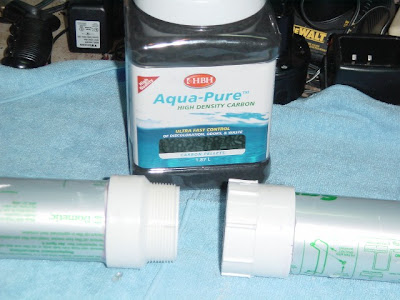
Step 7. Replace the retainer pads to each side of the filter. Add the carbon pellets to the filter filling both both sides full then close the filter tight.
Step 8. Replace the filter in the boat. You just saved about $100. Next season you can simply buy a container of the carbon pellets and do this entire project at the marina.
About this guide:
I first came across this idea at a online forum called Club Sea Ray. I’ve modified the original instructions after doing this project myself, but must give credit to Ken for posting this money savings do-it-yourself maintenance item with the above pictures. Here is a link to the original post. Link
The above information was prepared by Presentation Rentals a audiovisual equipment rental company in Appleton Wisconsin that offers LCD projector PA public address sound system and accessories. Visit them on the web at http://www.presentationrentals.net/
Boat - SeaRay 280 Sundancer
Port - Slip #2A, Skipper Buds, Oshkosh, WI
Lisa & Doug

Wednesday, October 24, 2007
Lake Winnebago regulation meeting notes October 24, 2007
Lake Winnebago regulation meeting notes October 24, 2007
I attended the ACOE (Army corps of engineers) Lake Winnebago regulation meeting today, October 24, 2007. Below are my personal notes from this meeting.
The ACOE will post their own notes to their website. I have provided a link to the relevant site at the bottom. Also, a copy of their presentation is available at the website. I provided a link to this as well.

I Welcome – from the ACOE
Introductions (I am guessing at name spelling. Please do not count on the spelling of names below. Please assume the spelling of all names is suspect. I did my best. )
Mike O’Brien – ACOE chief of Detroit office, includes Fox River system
Dave Hause – primary contact with public, also 24/7 dam operator, maintenance of gauges.
Bob Stanic – chief of office
Jim Benettis – chief of operations Kewaunee
Dave Fosters – Lake Michigan operations
Rich DeFauldie – Engineer
John Allis – chief of water shed
Missed - sorry
Lee Strum – deputy
General attendance: Property owners, Fox River navigation authority (Bob Stark), Various fishing clubs and groups, Utilities, multiple, Petri office representative, Steve Kagen office representative, Wolf River ???? could not hear her, Tri-Co power boat alliance, Thilmany Paper, Radtke construction, Oshkosh boat club, Friends of the Fox, General boaters, others, DNR. Sorry I messed some groups.
II Overview
The pool covers 6430 sq miles. It takes 7 days for rainwater to get from runoff from the pool north of Shawano to make its way to Lake Winnebago.
The ACOE is responsible for managing the level of water in the Winnebago Pool. They can adjust various gates on damns along the Fox River between Lake Winnebago and the bay of Green Bay.
Once the gates are completely closed they have no ability to raise the level of the water level. Water will continue to evaporate and will continue to flow over the spillway at the damn. The water will continue to flow over the spillway with the gates closed until the water reached a level of 1.75’ over Oshkosh datum.
The ACOE must balance the needs of the various stakeholders. For example, the Kaukauna utility uses the river to make electricity. To them, a constant flow of 4,500 is optimal for power production. Higher and the water is spilled over the top and wasted. Less and they are not able to product as much electricity.
III General 2008 projects & flow needs
PCB clean up – this will require tight regulation of the flow on the Fox River due to the need to keep various equipment buoyant.
Sewer work in Kaukauna, level must be dropped at specific times due to this project.
Spawning of fish – this is an annual need
Ski show called the water board warriors require a specific minimum levels. ACOE does its best to accommodate this.
Utilities and paper mills prefer a constant flow of 4,500.
Property owners require flood control.
Bridge construction in 2009 the College Ave Bridge will be replaced. Not likely to start in 2008 but possible.
Recreational boating – as more locks open there will be increased need to manager the level at each pool – 17 total pools including Lake Winnebago.
IV ACOE 2008 projects
Appleton Weir – needle damn 4x4 timbers are worn out. Some completed.
Kaukauna dike – sink holes – needs repair. Some repairs completed.
Clearing / grubbing – due to vegetation
DePere Trunnion repairs (Pins that hold the gates in place)
Appleton upper buoy ball cable – this is a safety cable, grab wire incase a boater is going over the damn. This is installed now. The goal is for this grab cable to be 3’ above the water. If a boater is going to go over the dam this gives the boater one last shot to grab this cable to prevent from going over the damn. The cable is to be present year round.
Down river gage upgrades – this will be new and will be similar to the Lake Winnebago data that is available now.
Menasha spillway – flow will exist as long as Winnebago is at 1.7” above datum or more. ACOE has no control over this spillway. Neenah was rebuilt. It was leaking. Now it is not leaking. Wood was replaced with cement.
There are 4 gauges in Lake Winnebago and 4 other data collection sites upriver to determine water level. Data is current on the ACOE website and is no more the 15 minutes delayed.
V 2007 season Weather review
May, June & July was dry in this area. By August, most of the area was in drought conditions. Late August rain relieved the drought conditions. Also, snowfall was light. 2007 was the 3rd summer in a row with below average precipitation. 2004 it was very wet and we had flooding.
May 22nd 2007 all gates (Neenah / Menasha) were closes and have remained closed since this time. Please note how Lake Winnebago dropped after this. This is the second earliest gate closing in the entire history. Evaporation is equivalent to an equal amount of water flow as the Fox River. Algae were strong. ACOE had requests to open gates to flush algae. They did for 4 hours in Menasha just before a ceremony. This was to relieve smell for the dedication. This was 1 time. The ACOE said this 4 hour opening has a insignificant effect on the overall level of the Winnebago pool. The algae smell returned quickly once the gates closed. There was a constant call to increase water flow for the PCB buildup. The ACOE was not able to accommodate this due to the low rainfall.
VI Plan for 2008
The fill plan is identical to 2007.
Early January the pool will be drawn down.
From Ice out (date varies – but normally mid to late March) the pool will be raised.
There will be a .3 foot operating band. Goal is to raise the level to 3.0 to 3.3 by June 1 to July 1. This is equal to 2007. 2004 is an example of flooding. It got too high to fast. The issue is May and June can have such a variation in rainfall.
VII Comments from the group
Comment / suggestion from a Lake Winnebago land owner.
Drop the water level sooner, like now, not January. Do it in October and draw the water level up more aggressively in spring. Get the gates closed sooner. This will reduce ice flows and increasing pleasure boating, reduced algae blooms.
Response from Art, from the DNR – re: winter draw down – for the lake ecosystem – he would not be apposed to this earlier draw down. He felt it would not have a positive nor gegative effect on the lake ecosystem.
Question: How fast can you draw the pool down?
Answer: The rate they can draw the pool down varies based on a lot of factors. If they were to pick a number, it’s theoretically possible to draw down the pool as much as ½ foot in 1 weeks time, assuming zero precipitation and no ground water runoff. In real world conditions, the process is slower then ½ foot / week. In 2004, they had a period of 6 weeks with all gates fully open with zero drop in level.
Question: How long does it take for rain in Northern portion of the basin to get to Lake Winnebago?
Answer: It takes about 1 week.
Question: Do you do pre-emptive gate opening? Say if there is a forecast of heavy rain. Answer: Yes, they can. They have not needed to in the last 3 years but they can.
Question: How much of a flood was 2004?
Answer - Per Art Decko with the DNR- this was a 25 year flood. This is average and can not predict with certainty when a flood of this level will return.
Question: When does ice go out in Lake Winnebago?
Answer: Mid March is typical lately. It’s been as late as April 10th. They have this data on the ACOE website. See link below.
Question: With gates closed, only spillway flow, will the Fox River navigational authority be able to use the lock system?
Answer: Yes. With water up to the spillway a boat can continue to navigate over the lock door threshold.
Question: When did the summer water level goal become 3.0 Oshkosh datum?
Answer: Per Art Decko from the DNR – 1982.
Question: What was the goal before 1982?
Answer: There was no goal. It was random. It was below 3.0. 3.0 is the highest goat that has ever existed before 2007 when the .3’ range was added making a goal range of 3.0 to 3.3’ over Oshkosh datum.
Question: What does 3.0 Oshkosh datum mean?
Answer: Its nothing more then a spot on a gauge. It’s meant for comparison purpose. There are presently 4 gauges on Lake Winnebago and 4 more on the upper portion of the system. More are being added to the lower Fox River. Data is electronically transmitted and uploaded to the ACOE website. Data is real time with not more then a 15 minute delay.
Question: Why not increase the level above 3.0?
Answer: The target range is 3.0 to 3.3 now. Flooding stage begins at 3.5. It would be irresponsible to have a target at flood stage.
Question: Why not move the target of 3.0 to a point earlier in the year?
Answer: In May 22, 2007, before the July 1 target date, we completely closed the gates. This was the second earliest we had ever done this. Our rainy season is May and June. We need to balance the needs of boaters with the other stakeholders of the Winnebago Pool including flood control.
Question: When did the ACOE stop dredging within this pool?
Answer: More then 25 years ago.
Question: When did the locks go into caretaker status?
Answer: 1983.
Question: What role does the ACOE serve for the Winnebago pool?
Answer: Dam maintenance and control of the water level for the Lake Winnebago pool and sub pools to Lake Michigan.
Question: Does the DNR control the water level? I heard a rumor that the water level is being held down for aquatic growth by the DNR.
Answer from Art Decko with the DNR: - Absolutely not. The DNR does not have the power to control the water level. We provide input, as does the other stakeholders as mentioned in the opening of the meeting. If the DNR had control over the water level it would be managed different. (Lots of chuckles in the room followed. Its understood Art Decko would like the water level much lower.)
Question: Doesn’t lower water levels mean greater aquatic growth?
Answer: Sometimes. Lower water level can cause more light to get further down and can result in more aquatic growth however this is only one factor. Another factor is water clarity.
Question for Art: Do you feel we have sufficient aquatic growth? I tool my dock out and it took 2 hours to remove all the growth. Last year too. I never had to do that and I’ve been on Winnebago for 67 years.
Answer from Art: We certainly have plenty of aquatic growth in Lake Winnebago. We are also having growth of invasive aquatic vegitation. The upper portion of the pool including Lake Poygon is suffering from low aquatic growth. The upper lakes are low on habitat.
Question: This spring we had a major fish die off. Why did this happen?
Answer from Art: The fish was mostly gizzard shad. We had a cold snap. They died by the millions. If we had a normal winter of ice cover the fish would have decayed. The issue was the lake opened up, the fish flowed into shore and marinas and you saw it and smelt it. The fish die off was caused by a cold snap. That is not the unusual part. The opening of the ice on the lake allowing the fish to float in to shore and gather in specific locations is what was unusual
Conclusion: Several people thanked the ACOE for this opportunity to meeting with the ACOE and hear their plan and answer questions.
Army Corps of Engineers Lake Winnebago Home Page:
http://www.lre.usace.army.mil/greatlakes/hh/lakewinnebago/
Copy of the presentation.
http://www.lre.usace.army.mil/hh/winnebago/regulation/regulation_meeting_presentation.pdf
I attended the ACOE (Army corps of engineers) Lake Winnebago regulation meeting today, October 24, 2007. Below are my personal notes from this meeting.
The ACOE will post their own notes to their website. I have provided a link to the relevant site at the bottom. Also, a copy of their presentation is available at the website. I provided a link to this as well.
I Welcome – from the ACOE
Introductions (I am guessing at name spelling. Please do not count on the spelling of names below. Please assume the spelling of all names is suspect. I did my best. )
Mike O’Brien – ACOE chief of Detroit office, includes Fox River system
Dave Hause – primary contact with public, also 24/7 dam operator, maintenance of gauges.
Bob Stanic – chief of office
Jim Benettis – chief of operations Kewaunee
Dave Fosters – Lake Michigan operations
Rich DeFauldie – Engineer
John Allis – chief of water shed
Missed - sorry
Lee Strum – deputy
General attendance: Property owners, Fox River navigation authority (Bob Stark), Various fishing clubs and groups, Utilities, multiple, Petri office representative, Steve Kagen office representative, Wolf River ???? could not hear her, Tri-Co power boat alliance, Thilmany Paper, Radtke construction, Oshkosh boat club, Friends of the Fox, General boaters, others, DNR. Sorry I messed some groups.
II Overview
The pool covers 6430 sq miles. It takes 7 days for rainwater to get from runoff from the pool north of Shawano to make its way to Lake Winnebago.
The ACOE is responsible for managing the level of water in the Winnebago Pool. They can adjust various gates on damns along the Fox River between Lake Winnebago and the bay of Green Bay.
Once the gates are completely closed they have no ability to raise the level of the water level. Water will continue to evaporate and will continue to flow over the spillway at the damn. The water will continue to flow over the spillway with the gates closed until the water reached a level of 1.75’ over Oshkosh datum.
The ACOE must balance the needs of the various stakeholders. For example, the Kaukauna utility uses the river to make electricity. To them, a constant flow of 4,500 is optimal for power production. Higher and the water is spilled over the top and wasted. Less and they are not able to product as much electricity.
III General 2008 projects & flow needs
PCB clean up – this will require tight regulation of the flow on the Fox River due to the need to keep various equipment buoyant.
Sewer work in Kaukauna, level must be dropped at specific times due to this project.
Spawning of fish – this is an annual need
Ski show called the water board warriors require a specific minimum levels. ACOE does its best to accommodate this.
Utilities and paper mills prefer a constant flow of 4,500.
Property owners require flood control.
Bridge construction in 2009 the College Ave Bridge will be replaced. Not likely to start in 2008 but possible.
Recreational boating – as more locks open there will be increased need to manager the level at each pool – 17 total pools including Lake Winnebago.
IV ACOE 2008 projects
Appleton Weir – needle damn 4x4 timbers are worn out. Some completed.
Kaukauna dike – sink holes – needs repair. Some repairs completed.
Clearing / grubbing – due to vegetation
DePere Trunnion repairs (Pins that hold the gates in place)
Appleton upper buoy ball cable – this is a safety cable, grab wire incase a boater is going over the damn. This is installed now. The goal is for this grab cable to be 3’ above the water. If a boater is going to go over the dam this gives the boater one last shot to grab this cable to prevent from going over the damn. The cable is to be present year round.
Down river gage upgrades – this will be new and will be similar to the Lake Winnebago data that is available now.
Menasha spillway – flow will exist as long as Winnebago is at 1.7” above datum or more. ACOE has no control over this spillway. Neenah was rebuilt. It was leaking. Now it is not leaking. Wood was replaced with cement.
There are 4 gauges in Lake Winnebago and 4 other data collection sites upriver to determine water level. Data is current on the ACOE website and is no more the 15 minutes delayed.
V 2007 season Weather review
May, June & July was dry in this area. By August, most of the area was in drought conditions. Late August rain relieved the drought conditions. Also, snowfall was light. 2007 was the 3rd summer in a row with below average precipitation. 2004 it was very wet and we had flooding.
May 22nd 2007 all gates (Neenah / Menasha) were closes and have remained closed since this time. Please note how Lake Winnebago dropped after this. This is the second earliest gate closing in the entire history. Evaporation is equivalent to an equal amount of water flow as the Fox River. Algae were strong. ACOE had requests to open gates to flush algae. They did for 4 hours in Menasha just before a ceremony. This was to relieve smell for the dedication. This was 1 time. The ACOE said this 4 hour opening has a insignificant effect on the overall level of the Winnebago pool. The algae smell returned quickly once the gates closed. There was a constant call to increase water flow for the PCB buildup. The ACOE was not able to accommodate this due to the low rainfall.
VI Plan for 2008
The fill plan is identical to 2007.
Early January the pool will be drawn down.
From Ice out (date varies – but normally mid to late March) the pool will be raised.
There will be a .3 foot operating band. Goal is to raise the level to 3.0 to 3.3 by June 1 to July 1. This is equal to 2007. 2004 is an example of flooding. It got too high to fast. The issue is May and June can have such a variation in rainfall.
VII Comments from the group
Comment / suggestion from a Lake Winnebago land owner.
Drop the water level sooner, like now, not January. Do it in October and draw the water level up more aggressively in spring. Get the gates closed sooner. This will reduce ice flows and increasing pleasure boating, reduced algae blooms.
Response from Art, from the DNR – re: winter draw down – for the lake ecosystem – he would not be apposed to this earlier draw down. He felt it would not have a positive nor gegative effect on the lake ecosystem.
Question: How fast can you draw the pool down?
Answer: The rate they can draw the pool down varies based on a lot of factors. If they were to pick a number, it’s theoretically possible to draw down the pool as much as ½ foot in 1 weeks time, assuming zero precipitation and no ground water runoff. In real world conditions, the process is slower then ½ foot / week. In 2004, they had a period of 6 weeks with all gates fully open with zero drop in level.
Question: How long does it take for rain in Northern portion of the basin to get to Lake Winnebago?
Answer: It takes about 1 week.
Question: Do you do pre-emptive gate opening? Say if there is a forecast of heavy rain. Answer: Yes, they can. They have not needed to in the last 3 years but they can.
Question: How much of a flood was 2004?
Answer - Per Art Decko with the DNR- this was a 25 year flood. This is average and can not predict with certainty when a flood of this level will return.
Question: When does ice go out in Lake Winnebago?
Answer: Mid March is typical lately. It’s been as late as April 10th. They have this data on the ACOE website. See link below.
Question: With gates closed, only spillway flow, will the Fox River navigational authority be able to use the lock system?
Answer: Yes. With water up to the spillway a boat can continue to navigate over the lock door threshold.
Question: When did the summer water level goal become 3.0 Oshkosh datum?
Answer: Per Art Decko from the DNR – 1982.
Question: What was the goal before 1982?
Answer: There was no goal. It was random. It was below 3.0. 3.0 is the highest goat that has ever existed before 2007 when the .3’ range was added making a goal range of 3.0 to 3.3’ over Oshkosh datum.
Question: What does 3.0 Oshkosh datum mean?
Answer: Its nothing more then a spot on a gauge. It’s meant for comparison purpose. There are presently 4 gauges on Lake Winnebago and 4 more on the upper portion of the system. More are being added to the lower Fox River. Data is electronically transmitted and uploaded to the ACOE website. Data is real time with not more then a 15 minute delay.
Question: Why not increase the level above 3.0?
Answer: The target range is 3.0 to 3.3 now. Flooding stage begins at 3.5. It would be irresponsible to have a target at flood stage.
Question: Why not move the target of 3.0 to a point earlier in the year?
Answer: In May 22, 2007, before the July 1 target date, we completely closed the gates. This was the second earliest we had ever done this. Our rainy season is May and June. We need to balance the needs of boaters with the other stakeholders of the Winnebago Pool including flood control.
Question: When did the ACOE stop dredging within this pool?
Answer: More then 25 years ago.
Question: When did the locks go into caretaker status?
Answer: 1983.
Question: What role does the ACOE serve for the Winnebago pool?
Answer: Dam maintenance and control of the water level for the Lake Winnebago pool and sub pools to Lake Michigan.
Question: Does the DNR control the water level? I heard a rumor that the water level is being held down for aquatic growth by the DNR.
Answer from Art Decko with the DNR: - Absolutely not. The DNR does not have the power to control the water level. We provide input, as does the other stakeholders as mentioned in the opening of the meeting. If the DNR had control over the water level it would be managed different. (Lots of chuckles in the room followed. Its understood Art Decko would like the water level much lower.)
Question: Doesn’t lower water levels mean greater aquatic growth?
Answer: Sometimes. Lower water level can cause more light to get further down and can result in more aquatic growth however this is only one factor. Another factor is water clarity.
Question for Art: Do you feel we have sufficient aquatic growth? I tool my dock out and it took 2 hours to remove all the growth. Last year too. I never had to do that and I’ve been on Winnebago for 67 years.
Answer from Art: We certainly have plenty of aquatic growth in Lake Winnebago. We are also having growth of invasive aquatic vegitation. The upper portion of the pool including Lake Poygon is suffering from low aquatic growth. The upper lakes are low on habitat.
Question: This spring we had a major fish die off. Why did this happen?
Answer from Art: The fish was mostly gizzard shad. We had a cold snap. They died by the millions. If we had a normal winter of ice cover the fish would have decayed. The issue was the lake opened up, the fish flowed into shore and marinas and you saw it and smelt it. The fish die off was caused by a cold snap. That is not the unusual part. The opening of the ice on the lake allowing the fish to float in to shore and gather in specific locations is what was unusual
Conclusion: Several people thanked the ACOE for this opportunity to meeting with the ACOE and hear their plan and answer questions.
Army Corps of Engineers Lake Winnebago Home Page:
http://www.lre.usace.army.mil/greatlakes/hh/lakewinnebago/
Copy of the presentation.
http://www.lre.usace.army.mil/hh/winnebago/regulation/regulation_meeting_presentation.pdf
Wednesday, August 29, 2007
Marine Radar – a beginner’s perspective
 When we purchased our current boat in June of 2007 it had marine radar already installed.
I wanted the radar to be more then a dash mounted device to impress guests. My goal was to use radar as a tool to aid in collision avoidance specifically during in poor visibility conditions. This would include small, unlit fishing boats that are common in our area.
I significantly underestimated how difficult it was to learn how to use this tool.
I had experience with GPS/charplotters. When I first got my GPS chartplotter I was using it and understanding what was on the screen minutes after powering it up for the first time. I had to read the manual to know how to make waypoints, tracks and routes, and change the screen so it was showing what I wanted but all totaled this took a couple of hours.
I found learning how to use Radar to be challenging and at times frustrating. A poor manual that was not written for beginners and having no one with experience that could answer questions added to the challenge.
Using radar and understanding what I was seeing on the screen and knowing how to make the proper adjustment to get the radar to perform took perseverance, practice and patience.
I made a commitment to use and understand this device.
Over the past 2+ months using radar I have just over 70 hours of experience using radar and many hours reading the manual and reading a marine radar tutorial. What I do is I use it, go back and read then use it more.
I use the radar all the time, even during the day when there is clear visibility so I gain experience with Radar and become familiar with what various targets look like on the screen when I can see them with my eyes. I identify targets on the screen then try to find them with my eyes.
I am just beginning to be able to look at the screen and say to a passenger “There are two birds flying directly behind the boat, about 50 feet behind us.”
When first installed there are initial settings that must be performed for the radar to operate properly. Since the initial settings were not set on our radar I don’t think the previous owners depended on the radar. Adjustments like the heading were way off. The heading adjustment is needed so what is directly in front of you is straight up on the display. The tuning, timing and clutter settings were also far out of proper adjustment. At the beginning nothing on the screen made sense. Now that I have some experience using radar and have gone thru the manual and the various initial setup adjustments I can tell when things are off. I’ve even went so far as to mess things up on purpose to gain experience at properly resetting the radar.
When I am on a lake and at least a mile off shore or more I set the range to 1.5 miles. This gives you a radius of 1.5 miles. The total screen covers 3 miles. I will zoom in to .25 miles when on a narrow river.
The first thing you may ask is “Why do you even have the radar running when you are boating on a narrow river?” Well, if you are in a wake zone you can see a faster boat coming up behind you as you are facing forward. Being aware of a boat that is going to pass you increases your safety. It prevents you from being startled or making a potentially dangerous course adjustment. A second reason to keep the radar on and zoomed in would be to gain experience.
I keep the range rings on. This means there are several circles on the screen, one inside the other, at a set calibration. Say you are at the 1.5 mile range setting and have 3 rings. A target that is at the outermost ring is 1.5 miles away. A target that is at the 2nd ring is 1 mile away, and so on. This allows you to estimate how far away a target is from you.
The better you adjust the various settings the better you can reduce clutter yet still see small targets. At first I set every adjustment I could to ‘auto adjusts.’ Today I keep all auto adjust settings off except tuning. Auto adjusting settings such as rain clutter, sea clutter, and tuning make using the radar easier however I have found I can adjust the unit better then it can.
If you are using radar for collision avoidance like me, you want to see that small flat bottom skiff with no lights at night. I find if I leave the settings on auto-adjust I loose small objects or gain so much clutter I can’t differentiate an actual target from interference.
I’m confident at adjusting the STC (sea clutter), FTC (rain clutter) and gain and can re-adjust these on the fly as sea and weather conditions change or when my location dictates that I need to adjust the range setting.
I’m getting better but it takes me time to get things adjusted correctly. Also, I am committed to continue my radar education and experience.
I’m glad to have radar and still consider myself to be a novice on the inclining part of the learning curve. However I am past the maddening steep part of the curve.
Monday, June 18, 2007
Tri-County Powerboat Alliance Brat Fry August 4 2007

August 7, 2007
Join in the food, music and fun at Gill’s Landing on the Wolf River.
Come by land or water.
Free-will donations for brats
Corn available for purchase
Noon until 4 p.m.
Proceeds go for Wolf River clean, safety and improvement projects.
Located 5 miles upstream from Fremont.
3 1/2 Miles East of Weyauwega on Cty.
Gill’s Landing, Weyauwega
For more information contact.. tcpa@centurytel.
h t t p : / / t c p a w e b . g o o g l e p a g e s . c o m /
Monday, June 11, 2007
Only 5 of 300 washed their boat after Lake Winnebago event
Lake Winnebago is infected with VHS virus — viral hemorrhagic septicemia.
To prevent the spread of this virus to other instate lakes the DNR has recommended washing boats including the hull, bilge and live wells.
This past weekend Lake Winnebago had the annual Walleye Weekend event in Fond du Lac.
There were 300 boats participating in the fishing tournament.
Volunteers brought in tucks with washing equipment. One truck had a mixture of bleach then the second had fresh water.
There was no fee for this.
Out of 300 boats participating in the walleye weekend fishing tournament, only 5 used this free service.
Only 5.
I first learned about this when I had the TV on this morning. I was watching the news and had channel 26 on. This is WGBA – NBC 26. They covered this story. The reporter was Claudia Hickey – phone 920-490-2672. I called the station and she was not in yet however the person in the news room was able to tell me that that company who provided the trucks with the equipment was:
Valley Hydro-Excavation, LLC
Contact: Jeff & Jackie Rindt
Address:
W1902 Town Hall Road
Campbellsport, WI 53010
Phone: (920) 533-5927
I next called Valley Hydro, got Jeff’s cell number and verified the information was correct, only 5 out of 300 boats washed their boats. The rest drove on past.
The company, Valley Hydro-Excavation, LLC, and its owners volunteered their time and had to turn down business to b e available for this event. I called and spoke to Jeff and he said he did this out of his hope to help prevent the spread of the VHS virus.
To make matters worse, they had a group of youth volunteers that were part of a little league and football team to do the work. The kids were also very disappointed.
To prevent the spread of this virus to other instate lakes the DNR has recommended washing boats including the hull, bilge and live wells.
This past weekend Lake Winnebago had the annual Walleye Weekend event in Fond du Lac.
There were 300 boats participating in the fishing tournament.
Volunteers brought in tucks with washing equipment. One truck had a mixture of bleach then the second had fresh water.
There was no fee for this.
Out of 300 boats participating in the walleye weekend fishing tournament, only 5 used this free service.
Only 5.
I first learned about this when I had the TV on this morning. I was watching the news and had channel 26 on. This is WGBA – NBC 26. They covered this story. The reporter was Claudia Hickey – phone 920-490-2672. I called the station and she was not in yet however the person in the news room was able to tell me that that company who provided the trucks with the equipment was:
Valley Hydro-Excavation, LLC
Contact: Jeff & Jackie Rindt
Address:
W1902 Town Hall Road
Campbellsport, WI 53010
Phone: (920) 533-5927
I next called Valley Hydro, got Jeff’s cell number and verified the information was correct, only 5 out of 300 boats washed their boats. The rest drove on past.
The company, Valley Hydro-Excavation, LLC, and its owners volunteered their time and had to turn down business to b e available for this event. I called and spoke to Jeff and he said he did this out of his hope to help prevent the spread of the VHS virus.
To make matters worse, they had a group of youth volunteers that were part of a little league and football team to do the work. The kids were also very disappointed.
Tuesday, May 22, 2007
Tri-County Powerboat Alliance Annual Wolf River Clean up

Tri-County Powerboat Alliance Annual Wolf River Clean up
May 20, 2007
Saturday June 2nd at 8:30 AM, the Tri-County Powerboat Alliance will hold its annual Wolf River clean up. It’s the Water Day version of Earth Day each year as members and the concerned citizens are welcome to join the river clean teams as they remove azardous materials and debris not only from the navigable river channel but also from the shores of the river. Last years event produced over a dozen drum barrels, buckets, along with various metal and garbage, both up and down river from Fremont.
All interested persons are to meet at the Partridge Beach on Wolf River Drive in Fremont at 8:30 A.M. If you have a watercraft such as a flat bottom boat able to get into shallow waters or a pontoon able to hold debris please bring it. It is recommended to wear gloves and waders or boots. With a great turn out last year and boat use donations from Ted’s Grandview, Pine Grove Resort, Blue Top Resort , Wolf Ridge Cottages, and Wolf River Marine, they were able to send teams each direction up and down river to cover more area.

The Tri-County Powerboat Alliance is a nonprofit organization dedicated to making the waterways from New London to Lake Winnebago a safe place for recreation. It’s goal is to promote safe boating and to preserve the Wolf River while maintaining its navigational use for all.
TCPA regularly conducts safe boater education classes, organizes river clean up projects, provides signs and other navigational aids, sponsors informational meetings, provides funds for dredging projects and works with state and local government officials to protect the waterway and its natural resources.
If you happen to see Alliance volunteers working on Saturday, June 2nd please wave and say thank for their work. Or join them for the annual fund raising brat fry at Gill’s Landing, Weyauwega, Saturday August 4th from noon till 4.
For more information contact TCPA@centurytel.net or Mike at 920 841-8372 or Judy at 920-450-7327. Or visit Tri-County Powerboat Alliance http://tcpaweb.googlepages.com
May 20, 2007
Saturday June 2nd at 8:30 AM, the Tri-County Powerboat Alliance will hold its annual Wolf River clean up. It’s the Water Day version of Earth Day each year as members and the concerned citizens are welcome to join the river clean teams as they remove azardous materials and debris not only from the navigable river channel but also from the shores of the river. Last years event produced over a dozen drum barrels, buckets, along with various metal and garbage, both up and down river from Fremont.
All interested persons are to meet at the Partridge Beach on Wolf River Drive in Fremont at 8:30 A.M. If you have a watercraft such as a flat bottom boat able to get into shallow waters or a pontoon able to hold debris please bring it. It is recommended to wear gloves and waders or boots. With a great turn out last year and boat use donations from Ted’s Grandview, Pine Grove Resort, Blue Top Resort , Wolf Ridge Cottages, and Wolf River Marine, they were able to send teams each direction up and down river to cover more area.
The Tri-County Powerboat Alliance is a nonprofit organization dedicated to making the waterways from New London to Lake Winnebago a safe place for recreation. It’s goal is to promote safe boating and to preserve the Wolf River while maintaining its navigational use for all.
TCPA regularly conducts safe boater education classes, organizes river clean up projects, provides signs and other navigational aids, sponsors informational meetings, provides funds for dredging projects and works with state and local government officials to protect the waterway and its natural resources.
If you happen to see Alliance volunteers working on Saturday, June 2nd please wave and say thank for their work. Or join them for the annual fund raising brat fry at Gill’s Landing, Weyauwega, Saturday August 4th from noon till 4.
For more information contact TCPA@centurytel.net or Mike at 920 841-8372 or Judy at 920-450-7327. Or visit Tri-County Powerboat Alliance http://tcpaweb.googlepages.com
Friday, May 18, 2007
VHS Confirmed in Lake Winnebago

Viral Hemorrhagic Septicemia (VHS) Confirmed in Lake Winnebago.

Menasha lock to resume operation at 4:00PM today, May 18, 2007. The lock will stay open for the season.

Wednesday, May 16, 2007
Questions and Answers on Viral Hemorrhagic Septicemia (VHS)
Important Questions and Answers on Viral Hemorrhagic Septicemia (VHS) in Great LakesFish.
During the past two years, the fish kills on Great Lakes have involved thousands of fish infected by the Viral Hemorrhagic Septicemia Virus (VHSV); this virus was not previously known to exist in the freshwater environment of North America.Here is some information on VHS compiled by NY Sea Grant.
What is VHS? What is the significance of the recent discovery of VHS in the Great Lakes?
Viral Hemorrhagic Septicemia is an infectious viral disease of fish that has been found in fish from the AtlanticCoast of Europe and Atlantic and PacificCoasts of North America. Historically, VHS was known as a very serious disease of freshwater-reared rainbow trout in Europe. At least four different genetic strains or forms of the virus are known to exist. The North American marine strain has a relatively low infection rate compared to that of the European freshwater strain.Until 2005, VHS was only found in the marine environment in North America. Several fish kills in the Lower Great Lakes since 2005 have been associated with VHS. To date, VHS has been confirmed from wild fish in the Bay of Quinte Lake Ontario, Lake St. Clair, Lake Erie and the St. Lawrence River. Scientists believe that this appearance may represent an invasion of the freshwater strain in North America.
What North American freshwater fish species are affected?
In the Great Lakes, VHS has been found in smallmouth bass, yellow perch, crappie, muskellunge, northern pike, bluegill, walleye, round gobies, sheepshead, and some sucker species. Scientists are concerned; however, that VHS could also strike native salmonids such as trout, salmon and whitefish in the wild, and salmonids in hatcheries and net pen operations.
How did VHS get here?
It is unclear how the virus spread to the Great Lakes; it is possible the marine virus may have been introduced to the Great Lakes some time ago and it simply evolved to live in freshwater.The VHS virus is a strain that undergoes rapid mutations (spontaneous genetic changes) and may have adapted to freshwater environments in North America. Recently, VHS was found in stored fish samples that were collected in the Great Lakes during 2003, suggesting the virus has been present in the Great Lakes for some time.
How does VHS spread?
It is unclear exactly how the disease is spread but it appears that the virus can be shed by infected fish into the water through metabolic waste materials, particularly by fish that survive the disease and become carriers. It also appears that carrier fish or offspring of carriers become more resistant to the disease. The virus can infect fish of all ages. It may enter a host fish through the gills or food or contact with some contaminated object. It does appear that stressed fish more vulnerable to viral infection. Typical fish stressors include sudden water temperature changes, crowded hatchery conditions and, spawning activity.The timing of the recent fish die-off in the Great Lakes coincided with the spawning by some of the fish species, such as muskellunge.
What does it do to fish? What are the symptoms of a fish with VHSV infection?Like many fish diseases, the type of symptoms present in a fish change with the severity of the infection.At low infection intensity fish may display few to no symptoms as is the case in most wild disease outbreaks.Hatchery or pen-reared fish are much more susceptible because of the confined conditions. As the infection severity increases, fish become darker and the eyes bulge with some bleeding around the eye and base of the fins. The gills are usually quite pale with some pin point bleeding.Mortalities appear at this point because hemorrhaging reduces the oxygen carrying ability of the blood. Dark red patches may appear on the front and sides of the head.
If the fish is opened up, bleeding on the surfaces of the intestine, liver, swim bladder can be seen. Fluid also builds up in the body cavity giving the fish a swollen belly. Later, if infection increases, the body continues to darken and the eyes really stick out of the head. At this point, the gills look gray or even white and the fish may swim in a corkscrew pattern. Most fish kills from VHS occur in water temperatures from 40 to 60 F (3-12 C) and few occur at temperatures above 62 F (15 C).NOTE:The detection of a VHS infection can only be made from sophisticated laboratory testing.A diagnosis cannot be made based solely on the observation of visible signs because many different diseases of fish have very similar signs of disease.
What is the long-term outlook for VHVS in the Great Lakes?
Diseases like VHS run their course just as they do in human populations. At first mortalities may appear to be large, but many biologists believe that most fish can survive the disease if they are not otherwise stressed because mortalities generally occur in weaker, stressed fish. The remainder will build up a natural immunity to the virus and the numbers of fish killed by the virus will decline.
Is it a health risk to people?
There is no apparent health risk for people contracting VHS.Because it takes a long time to identify the causes of fish kills in lab studies, people should be cautioned against handling or eating any fish that does not act or appear to be healthy because of the risk of contracting avian botulism a bacterial disease that does pose a human health threat.
What is being done to control it or prevent it?
One of the best management options is containment.Efforts should be made to eliminate or reduce the potential spread of the virus from the locations where it is known to exist.Actions such as not moving fish from the endemic area to areas outside the Great Lakes may be important.Many of the same preventative actions that are taken to reduce the spread of invasive species may also be appropriate.These include cleaning of boats before moving them between different bodies of water; cleaning, draining and drying of live wells and not moving bait minnows or other live bait from an endemic area to a non-infected area.To be fully effective, these containment efforts will need to be practiced by all users of the aquatic resource.
In a hatchery, the best means of controlling the disease is to prevent the contact of the virus and fish. This can be done by hatchery disinfection, egg treatment with anti-viral agents, and using ultra-violet light treatment of hatchery water. It is important to stock disease free fish and to monitor freshwater populations for signs of further spread.Information on diseased wild fish is difficult to obtain because they often die undetected and fish can decompose rapidly making disease diagnoses very difficult.New research is being developed that would allow more rapid detection of the disease.
What should I do if I see a fish kill?
If you observe a fish kill on the Great Lakes, please contact the Wisconsin Department of Natural Resources at (608) 266-8782 or your local DNR office. If you see fish with any of the outward signs of VHS as described above please mention this as well.This will help biologists keep track of where the disease may be appearing.
Source
During the past two years, the fish kills on Great Lakes have involved thousands of fish infected by the Viral Hemorrhagic Septicemia Virus (VHSV); this virus was not previously known to exist in the freshwater environment of North America.Here is some information on VHS compiled by NY Sea Grant.
What is VHS? What is the significance of the recent discovery of VHS in the Great Lakes?
Viral Hemorrhagic Septicemia is an infectious viral disease of fish that has been found in fish from the AtlanticCoast of Europe and Atlantic and PacificCoasts of North America. Historically, VHS was known as a very serious disease of freshwater-reared rainbow trout in Europe. At least four different genetic strains or forms of the virus are known to exist. The North American marine strain has a relatively low infection rate compared to that of the European freshwater strain.Until 2005, VHS was only found in the marine environment in North America. Several fish kills in the Lower Great Lakes since 2005 have been associated with VHS. To date, VHS has been confirmed from wild fish in the Bay of Quinte Lake Ontario, Lake St. Clair, Lake Erie and the St. Lawrence River. Scientists believe that this appearance may represent an invasion of the freshwater strain in North America.
What North American freshwater fish species are affected?
In the Great Lakes, VHS has been found in smallmouth bass, yellow perch, crappie, muskellunge, northern pike, bluegill, walleye, round gobies, sheepshead, and some sucker species. Scientists are concerned; however, that VHS could also strike native salmonids such as trout, salmon and whitefish in the wild, and salmonids in hatcheries and net pen operations.
How did VHS get here?
It is unclear how the virus spread to the Great Lakes; it is possible the marine virus may have been introduced to the Great Lakes some time ago and it simply evolved to live in freshwater.The VHS virus is a strain that undergoes rapid mutations (spontaneous genetic changes) and may have adapted to freshwater environments in North America. Recently, VHS was found in stored fish samples that were collected in the Great Lakes during 2003, suggesting the virus has been present in the Great Lakes for some time.
How does VHS spread?
It is unclear exactly how the disease is spread but it appears that the virus can be shed by infected fish into the water through metabolic waste materials, particularly by fish that survive the disease and become carriers. It also appears that carrier fish or offspring of carriers become more resistant to the disease. The virus can infect fish of all ages. It may enter a host fish through the gills or food or contact with some contaminated object. It does appear that stressed fish more vulnerable to viral infection. Typical fish stressors include sudden water temperature changes, crowded hatchery conditions and, spawning activity.The timing of the recent fish die-off in the Great Lakes coincided with the spawning by some of the fish species, such as muskellunge.
What does it do to fish? What are the symptoms of a fish with VHSV infection?Like many fish diseases, the type of symptoms present in a fish change with the severity of the infection.At low infection intensity fish may display few to no symptoms as is the case in most wild disease outbreaks.Hatchery or pen-reared fish are much more susceptible because of the confined conditions. As the infection severity increases, fish become darker and the eyes bulge with some bleeding around the eye and base of the fins. The gills are usually quite pale with some pin point bleeding.Mortalities appear at this point because hemorrhaging reduces the oxygen carrying ability of the blood. Dark red patches may appear on the front and sides of the head.
If the fish is opened up, bleeding on the surfaces of the intestine, liver, swim bladder can be seen. Fluid also builds up in the body cavity giving the fish a swollen belly. Later, if infection increases, the body continues to darken and the eyes really stick out of the head. At this point, the gills look gray or even white and the fish may swim in a corkscrew pattern. Most fish kills from VHS occur in water temperatures from 40 to 60 F (3-12 C) and few occur at temperatures above 62 F (15 C).NOTE:The detection of a VHS infection can only be made from sophisticated laboratory testing.A diagnosis cannot be made based solely on the observation of visible signs because many different diseases of fish have very similar signs of disease.
What is the long-term outlook for VHVS in the Great Lakes?
Diseases like VHS run their course just as they do in human populations. At first mortalities may appear to be large, but many biologists believe that most fish can survive the disease if they are not otherwise stressed because mortalities generally occur in weaker, stressed fish. The remainder will build up a natural immunity to the virus and the numbers of fish killed by the virus will decline.
Is it a health risk to people?
There is no apparent health risk for people contracting VHS.Because it takes a long time to identify the causes of fish kills in lab studies, people should be cautioned against handling or eating any fish that does not act or appear to be healthy because of the risk of contracting avian botulism a bacterial disease that does pose a human health threat.
What is being done to control it or prevent it?
One of the best management options is containment.Efforts should be made to eliminate or reduce the potential spread of the virus from the locations where it is known to exist.Actions such as not moving fish from the endemic area to areas outside the Great Lakes may be important.Many of the same preventative actions that are taken to reduce the spread of invasive species may also be appropriate.These include cleaning of boats before moving them between different bodies of water; cleaning, draining and drying of live wells and not moving bait minnows or other live bait from an endemic area to a non-infected area.To be fully effective, these containment efforts will need to be practiced by all users of the aquatic resource.
In a hatchery, the best means of controlling the disease is to prevent the contact of the virus and fish. This can be done by hatchery disinfection, egg treatment with anti-viral agents, and using ultra-violet light treatment of hatchery water. It is important to stock disease free fish and to monitor freshwater populations for signs of further spread.Information on diseased wild fish is difficult to obtain because they often die undetected and fish can decompose rapidly making disease diagnoses very difficult.New research is being developed that would allow more rapid detection of the disease.
What should I do if I see a fish kill?
If you observe a fish kill on the Great Lakes, please contact the Wisconsin Department of Natural Resources at (608) 266-8782 or your local DNR office. If you see fish with any of the outward signs of VHS as described above please mention this as well.This will help biologists keep track of where the disease may be appearing.
Source
Sunday, May 13, 2007
Notice: Menasha Lock Closed as of May 12, 2007
Notice: Menasha Lock Closed
The Menasha lock has been closed as of Saturday May 12th.
The Menasha lock closed at the request of the DNR after the discovery of a virus in fish that were harvested in Little Lake Butte des Morts in Menasha.
Official release #1)
(Appleton, WI) The Fox River Navigational System Authority suspended the operation of the Menasha Lock today in response to a report that the Viral Hemorrhagic Septicemia (VHS) virus was preliminarily discovered in a fish sample taken from Little Lake Butte des Morts earlier this month.Two samples of freshwater drum, (sheepshead), were collected on May 2, 2007 from Little Lake Butte de Morts by DNR fisheries staff. On May 11th the University of Wisconsin Veterinary Diagnostic Lab informed the DNR that the samples tested positive for VHS.
Additional testing is being done to confirm the presence of the virus.“Protecting our waterways and our fisheries from Aquatic Invasive Species has been the number one pledge of the Navigational Authority since work began to restore and operate the 150 year old historic lock system on the lower Fox River,” said Bob Stark, chairman of the Authority. “When we received word that a preliminary positive test for the VHS virus was reported in Little Lake Butte des Morts, our immediate response must be to honor that pledge and to do what we can to fight the spread of AIS,” he added. “Therefore, I have ordered the Menasha Lock to be closed and not to be operated until further notice.”According to the DNR it is not known how the virus entered Little Lake Butte des Morts. The virus is carried in live and dead fish and on fish eggs.
Equipment that comes into contact with fish (live wells, bait buckets, nets and the like) is also a possible vector. Additional testing of fish in other areas is now being done, including Lake Winnebago. The virus poses no risk to human health.The DNR is asking all anglers, boaters and others using the water to take voluntary steps to prevent the spread of this deadly disease. The preliminary message is that all anglers and boaters need to take personal responsibility for not spreading this virus (and other invasive species) by:
• NEVER moving live fish or fish eggs (including bait) to other waters
• ALWAYS draining all water from their boats after use
• ALWAYS obtaining bait minnows from approved sources (WI bait dealers or harvest yourself in the water you'll be fishing)
• RINSE the boat with hot water or let it dry in the sun for 5 days before moving to new waters
• Clean equipment (live wells, nets etc) with a bleach solution, (1/3 cup bleach to 5 gallons of water, in contact with equipment for 5 minutes)
Notice of the Menasha Lock closure will be sent to boat clubs and marinas on the system.
Questions regarding the operational status of the Menasha Lock can be directed to Harlan Kiesow, CEO of the Fox River Navigational System Authority at (920)759-9833.
Release #2)
DATE: May 12, 2007
CONTACT: Mike Staggs, Fisheries Director, (608)220-2609George Boronow, Regional Fisheries Coordinator, (920)662-5426
SUBJECT: Fish likely infected with deadly virus found in Little Lake Butte des Morts;Menasha Lock closed; Public asked to take steps to stop the spread
MADISON – The Department of Natural Resources announced Saturday that two fish from Little Lake Butte des Morts in the Lake Winnebago chain of lakes have preliminarily tested positive for the deadly fish virus called viral hemorrhagic septicemia or (VHS).
Additional dead fish samples taken from Lake Winnebago, itself, appear to have the virus.
Though VHS is not a health threat for people who eat or handle fish infected with the virus, it can infect more than 25 game fish, panfish and bait fish species. State fish managers had suspected it to be present in Lake Michigan and possibly in Lake Superior and in the Mississippi River. This would be the first infection to be confirmed in Wisconsin inland waters. Wisconsin recently enacted emergency rules for boaters, anglers and people who harvest wild bait to prevent the spread of VHS in inland waters http://dnr.wi.gov/org/caer/ce/news/rbnews/BreakingNews_Lookup.asp?id=497
“This is a major fish health crisis,” said Fisheries Director Mike Staggs, “We have to take aggressive steps now and enlist the help of the public to stop this spread.” Fish managers met Saturday to implement immediate steps to deal with the infection and limit its spread. DNR asked the Fox Locks Authority to close the Menasha Lock immediately and to keep it closed until more information about the spread of the disease could be confirmed; boaters can expect to be turned back from the lock starting today. In addition, DNR began the process of posting all boat launches with actions boaters should take to avoid spreading the disease. “We need to err on every possible side of caution,” Staggs said. “Believe me, nobody wants to see this disease get into more of our lakes. Do not take live fish (including unused bait minnows) away from the landing or shore. Drain all water from bilges, bait buckets, live wells, and other containers when leaving the landing or shore.” Little Lake Butte des Morts is downstream from Lake Winnebago and separated by one dam and one functioning lock, which has now been closed. The Lake Winnebago chain is home to Wisconsin’s unique sturgeon population. On May 11, 2007 the University of Wisconsin Veterinary Diagnostic Lab (WVDL) informed DNR that two samples of freshwater drum taken from Little Lake Butte des Morts on May 2, 2007 had tested positive for VHS. The samples have been sent to an approved federal lab for confirmation. The fish were collected by DNR fisheries staff during muskellunge spawning netting and were submitted for testing because they had shown external signs of VHS. Since that time, DNR has been receiving reports of hundreds of freshwater drum dying on Lake Winnebago, itself. On May 9 and 10 samples of those dead fish were sent to WVDL for testing. A visual inspection of the Lake Winnebago fish by DNR’s certified fish health inspector showed the same external signs of VHS as the Little Lake Butte des Morts fish. Also the DNR staff that collected the fish on Little Lake Butte des Morts reported seeing dead and dying drum washing over the dam separating that water from Lake Winnebago. Because the virus can infect so many different ages and species of fish, VHS could spread more quickly in inland lakes, which are much smaller than the Great Lakes, potentially devastating fish populations and fishing opportunities. Walleye, spotted musky, yellow perch, bluegill and northern pike are all susceptible to the virus, as are common bait species such as emerald and spot-tail shiners.
DNR is appealing to anglers, boaters and other water users to help prevent the further spread of VHS by taking a few simple steps:
• Never move live fish or fish eggs to other waters and always buy bait minnows only from Wisconsin bait dealers because bait from other states may not have been tested for VHS. These steps are required by the new emergency rules.
• Inspect boat, trailer and equipment and remove visible aquatic plants, animals, and mud before leaving the lake launch.
• Drain water from boat, motor, bilge, live wells, and bait containers before leaving a lake. This step is recommended for boaters on all waters and is required under the emergency rules for boaters on the Great Lakes and the Mississippi River and their tributaries up to the first dam.
• Dispose of leftover bait in the trash, not in the water. Do not take live fish or live fish eggs away from the boat landing.
• Rinse boat and recreational equipment with hot water OR dry for at least five days.
• Report large numbers of dead fish or fish with bloody spots to your local DNR fish biologist or conservation warden.
Wisconsin already has taken steps to deal with VHS. The state Natural Resources Board on Wednesday, April 4, unanimously passed emergency rules prohibiting anglers and boaters from moving live fish, and requiring them to drain their boats and livewells, before leaving Wisconsin’s Great Lakes waters, the Mississippi River and those waters’ tributaries up to the first dam.
Fishing in Wisconsin is a $2.3 billion industry.
More information on aquatic invasive species and Wisconsin’s programs to prevent their spread is available on the DNR Web site.
For more information about VHS please see http://dnr.wi.gov/fish/pages/vhs.html
The Menasha lock has been closed as of Saturday May 12th.
The Menasha lock closed at the request of the DNR after the discovery of a virus in fish that were harvested in Little Lake Butte des Morts in Menasha.
Official release #1)
(Appleton, WI) The Fox River Navigational System Authority suspended the operation of the Menasha Lock today in response to a report that the Viral Hemorrhagic Septicemia (VHS) virus was preliminarily discovered in a fish sample taken from Little Lake Butte des Morts earlier this month.Two samples of freshwater drum, (sheepshead), were collected on May 2, 2007 from Little Lake Butte de Morts by DNR fisheries staff. On May 11th the University of Wisconsin Veterinary Diagnostic Lab informed the DNR that the samples tested positive for VHS.
Additional testing is being done to confirm the presence of the virus.“Protecting our waterways and our fisheries from Aquatic Invasive Species has been the number one pledge of the Navigational Authority since work began to restore and operate the 150 year old historic lock system on the lower Fox River,” said Bob Stark, chairman of the Authority. “When we received word that a preliminary positive test for the VHS virus was reported in Little Lake Butte des Morts, our immediate response must be to honor that pledge and to do what we can to fight the spread of AIS,” he added. “Therefore, I have ordered the Menasha Lock to be closed and not to be operated until further notice.”According to the DNR it is not known how the virus entered Little Lake Butte des Morts. The virus is carried in live and dead fish and on fish eggs.
Equipment that comes into contact with fish (live wells, bait buckets, nets and the like) is also a possible vector. Additional testing of fish in other areas is now being done, including Lake Winnebago. The virus poses no risk to human health.The DNR is asking all anglers, boaters and others using the water to take voluntary steps to prevent the spread of this deadly disease. The preliminary message is that all anglers and boaters need to take personal responsibility for not spreading this virus (and other invasive species) by:
• NEVER moving live fish or fish eggs (including bait) to other waters
• ALWAYS draining all water from their boats after use
• ALWAYS obtaining bait minnows from approved sources (WI bait dealers or harvest yourself in the water you'll be fishing)
• RINSE the boat with hot water or let it dry in the sun for 5 days before moving to new waters
• Clean equipment (live wells, nets etc) with a bleach solution, (1/3 cup bleach to 5 gallons of water, in contact with equipment for 5 minutes)
Notice of the Menasha Lock closure will be sent to boat clubs and marinas on the system.
Questions regarding the operational status of the Menasha Lock can be directed to Harlan Kiesow, CEO of the Fox River Navigational System Authority at (920)759-9833.
Release #2)
DATE: May 12, 2007
CONTACT: Mike Staggs, Fisheries Director, (608)220-2609George Boronow, Regional Fisheries Coordinator, (920)662-5426
SUBJECT: Fish likely infected with deadly virus found in Little Lake Butte des Morts;Menasha Lock closed; Public asked to take steps to stop the spread
MADISON – The Department of Natural Resources announced Saturday that two fish from Little Lake Butte des Morts in the Lake Winnebago chain of lakes have preliminarily tested positive for the deadly fish virus called viral hemorrhagic septicemia or (VHS).
Additional dead fish samples taken from Lake Winnebago, itself, appear to have the virus.
Though VHS is not a health threat for people who eat or handle fish infected with the virus, it can infect more than 25 game fish, panfish and bait fish species. State fish managers had suspected it to be present in Lake Michigan and possibly in Lake Superior and in the Mississippi River. This would be the first infection to be confirmed in Wisconsin inland waters. Wisconsin recently enacted emergency rules for boaters, anglers and people who harvest wild bait to prevent the spread of VHS in inland waters http://dnr.wi.gov/org/caer/ce/news/rbnews/BreakingNews_Lookup.asp?id=497
“This is a major fish health crisis,” said Fisheries Director Mike Staggs, “We have to take aggressive steps now and enlist the help of the public to stop this spread.” Fish managers met Saturday to implement immediate steps to deal with the infection and limit its spread. DNR asked the Fox Locks Authority to close the Menasha Lock immediately and to keep it closed until more information about the spread of the disease could be confirmed; boaters can expect to be turned back from the lock starting today. In addition, DNR began the process of posting all boat launches with actions boaters should take to avoid spreading the disease. “We need to err on every possible side of caution,” Staggs said. “Believe me, nobody wants to see this disease get into more of our lakes. Do not take live fish (including unused bait minnows) away from the landing or shore. Drain all water from bilges, bait buckets, live wells, and other containers when leaving the landing or shore.” Little Lake Butte des Morts is downstream from Lake Winnebago and separated by one dam and one functioning lock, which has now been closed. The Lake Winnebago chain is home to Wisconsin’s unique sturgeon population. On May 11, 2007 the University of Wisconsin Veterinary Diagnostic Lab (WVDL) informed DNR that two samples of freshwater drum taken from Little Lake Butte des Morts on May 2, 2007 had tested positive for VHS. The samples have been sent to an approved federal lab for confirmation. The fish were collected by DNR fisheries staff during muskellunge spawning netting and were submitted for testing because they had shown external signs of VHS. Since that time, DNR has been receiving reports of hundreds of freshwater drum dying on Lake Winnebago, itself. On May 9 and 10 samples of those dead fish were sent to WVDL for testing. A visual inspection of the Lake Winnebago fish by DNR’s certified fish health inspector showed the same external signs of VHS as the Little Lake Butte des Morts fish. Also the DNR staff that collected the fish on Little Lake Butte des Morts reported seeing dead and dying drum washing over the dam separating that water from Lake Winnebago. Because the virus can infect so many different ages and species of fish, VHS could spread more quickly in inland lakes, which are much smaller than the Great Lakes, potentially devastating fish populations and fishing opportunities. Walleye, spotted musky, yellow perch, bluegill and northern pike are all susceptible to the virus, as are common bait species such as emerald and spot-tail shiners.
DNR is appealing to anglers, boaters and other water users to help prevent the further spread of VHS by taking a few simple steps:
• Never move live fish or fish eggs to other waters and always buy bait minnows only from Wisconsin bait dealers because bait from other states may not have been tested for VHS. These steps are required by the new emergency rules.
• Inspect boat, trailer and equipment and remove visible aquatic plants, animals, and mud before leaving the lake launch.
• Drain water from boat, motor, bilge, live wells, and bait containers before leaving a lake. This step is recommended for boaters on all waters and is required under the emergency rules for boaters on the Great Lakes and the Mississippi River and their tributaries up to the first dam.
• Dispose of leftover bait in the trash, not in the water. Do not take live fish or live fish eggs away from the boat landing.
• Rinse boat and recreational equipment with hot water OR dry for at least five days.
• Report large numbers of dead fish or fish with bloody spots to your local DNR fish biologist or conservation warden.
Wisconsin already has taken steps to deal with VHS. The state Natural Resources Board on Wednesday, April 4, unanimously passed emergency rules prohibiting anglers and boaters from moving live fish, and requiring them to drain their boats and livewells, before leaving Wisconsin’s Great Lakes waters, the Mississippi River and those waters’ tributaries up to the first dam.
Fishing in Wisconsin is a $2.3 billion industry.
More information on aquatic invasive species and Wisconsin’s programs to prevent their spread is available on the DNR Web site.
For more information about VHS please see http://dnr.wi.gov/fish/pages/vhs.html
Tuesday, May 08, 2007
Menasha lock to being opening for 2007 boating season May 11
The Menasha lock will being opening for 2007 boating season on Friday May 11, 2007 at 10:00 AM.

Photo from www.gwo-main.com
Hours of operation are:
Monday thru Thursday 10:00 AM until 10:00 PM
Friday thru Sunday 8:00 AM until 10:00 PM
The cost to use the lock has been raised to $6.00 for boats less then 26 feet and $12.00 for boats 26 feet and up. If you are going to go back thru the lock the same day they will give you a ticket stub and there is no additional fee for this return trip.
You can also purchase a seasonal ticket for $120.
This lock is hand operated and is a enjoyable experience for the family.
Friday, May 04, 2007
Sea Ray Sundancer 240 cabin cruiser w/ trailer used boat for sale
***** Update May 25, 2007 SOLD *****
 Sea Ray Sundancer 240 cabin cruiser w/ steel ShoreLand'r trailer
This is the perfect sized express family cruiser. The size is not too big for skiing, tubing, or fishing and not too small for 4 adults to spend the night in the cabin .
.
 The boat comes with a full Camper top with enclosure. You can use the top for shade on those hot summer days or completely enclose the cockpit area for those cooler times allowing you to use the boat for an extended season. There’s even a windshield wiper. The Cockpit has a port lounge and a table giving you plenty of room to entertain 8 adults.

The cabin has a galley with dual voltage refrigerator, sink with pressurized water, a separate head compartment and a table that can be lowered for an oversized V-berth for two adults. Abaft the galley is a mid-birth that is plenty large enough to sleep two additional adults.

Also, the boat has a swim platform with a shower / wash down and boarding ladder.
 This boat is built Sea Ray strong and is powered by a fuel ejected 5.0 L V8 Mercruiser with only 394 hours connected to the very reliable Alpha I gen II Inboard/Outboard drive.

The boat comes with 120V shore power + battery charging system, dual deep cycle multi-purpose marine batteries that are new in April 2007 and built-in battery selector switch, dual voltage fridge, gas stove, separate head compartment with pump-out.
This boat passed a coast guard voluntary vessel safety inspection May 3rd 2007. The examiner kept commenting how nice the condition the boat was in and even complemented the cleanliness of the engine compartment. A copy of this inspection is available upon request.
This is a 1998 Sea Ray 240DA Sundancer and the price includes the trailer. This is a versatile, fun, economical family express cruiser.

We are not boat brokers. Buy direct from the owner and save the 10% broker commission.
This is our personal boat and we are motivated to sell to move to a larger boat.
 Sea Ray Sundancer 240 cabin cruiser w/ steel ShoreLand'r trailer
This is the perfect sized express family cruiser. The size is not too big for skiing, tubing, or fishing and not too small for 4 adults to spend the night in the cabin
. The boat comes with a full Camper top with enclosure. You can use the top for shade on those hot summer days or completely enclose the cockpit area for those cooler times allowing you to use the boat for an extended season. There’s even a windshield wiper. The Cockpit has a port lounge and a table giving you plenty of room to entertain 8 adults.The cabin has a galley with dual voltage refrigerator, sink with pressurized water, a separate head compartment and a table that can be lowered for an oversized V-berth for two adults.
Abaft the galley is a mid-birth that is plenty large enough to sleep two additional adults.Also, the boat has a swim platform with a shower / wash down and boarding ladder.
This boat is built Sea Ray strong and is powered by a fuel ejected 5.0 L V8 Mercruiser with only 394 hours connected to the very reliable Alpha I gen II Inboard/Outboard drive. This boat has been professionally serviced my AJ Marine. The outdrive has been pulled, inspected, serviced, replaced and is very clean.
The boat comes with 120V shore power + battery charging system, dual deep cycle multi-purpose marine batteries that are new in April 2007 and built-in battery selector switch, dual voltage fridge, gas stove, separate head compartment with pump-out.
This boat passed a coast guard voluntary vessel safety inspection May 3rd 2007. The examiner kept commenting how nice the condition the boat was in and even complemented the cleanliness of the engine compartment. A copy of this inspection is available upon request.
This is a 1998 Sea Ray 240DA Sundancer and the price includes the trailer. This is a versatile, fun, economical family express cruiser.
We are not boat brokers. Buy direct from the owner and save the 10% broker commission.
This is our personal boat and we are motivated to sell to move to a larger boat.
For sale at $26,900.
Please call *** SOLD ***
Please call *** SOLD ***
Thursday, April 26, 2007
Unexpected repair expenses
It seems like at the start of each season I have some unexpected repair expenses. Things like slip cost, insurance, fuel, and maintenance are part of the regular costs of boating.
The screen on my GPS/Chart plotter is leaking liquid crystal. For reference, it smells like dish soap.
The second bad news is I am past warranty but I don’t think this would have been covered anyways. I did remove the unit from my boat and stored it in a box in the basement. I think one of the kids must have played with it and dropped it and put it back. I do blame myself. Should have kept it in my bedroom.
The good news is the manufacturer will do a ‘swap-out’ with a rebuilt unit and will transfer the waypoints / routs / etc and send me a refurbished unit for $175. I’m sending it out next day air today. I should get the refurbished unit with a 90 day warranty by next Friday.
With shipping I’m out less then $200, far less then replacement cost of a new unit.
Oh-well. I hope this is it for unexpected repairs. With the slip ($1,450/season – paid in full up front), insurance, new batteries, repairs to the canvas, and this GPS thing I am now over two grand and I have not got the boat in the water yet.
The screen on my GPS/Chart plotter is leaking liquid crystal. For reference, it smells like dish soap.
The second bad news is I am past warranty but I don’t think this would have been covered anyways. I did remove the unit from my boat and stored it in a box in the basement. I think one of the kids must have played with it and dropped it and put it back. I do blame myself. Should have kept it in my bedroom.
The good news is the manufacturer will do a ‘swap-out’ with a rebuilt unit and will transfer the waypoints / routs / etc and send me a refurbished unit for $175. I’m sending it out next day air today. I should get the refurbished unit with a 90 day warranty by next Friday.
With shipping I’m out less then $200, far less then replacement cost of a new unit.
Oh-well. I hope this is it for unexpected repairs. With the slip ($1,450/season – paid in full up front), insurance, new batteries, repairs to the canvas, and this GPS thing I am now over two grand and I have not got the boat in the water yet.
Wednesday, April 25, 2007
Oshkosh railroad bridge begins operation April 27, 2007
Spanning across the Fox River in Oshkosh is a railroad bridge.

Per the C.N. operations center in Stevens Point WI, the Oshkosh railroad bridge will begin operation for the 2007 boating season on Friday April 27 8:00 AM.
This railroad swing bridge is operated automatically from Stevens Point Wisconsin. The bridge is normally open unless a train is coming.
You can reach the C.N. operations center by calling 715-345-2487. Put that in your cell phone. Call them if its closed.
I have called the number and alerted them I was waiting and they would perform a short opening between trains so I could continue my voyage.
Do-it-yourself Boat cleaning tips and tricks
Do-it-yourself Boat cleaning tips and tricks
Some tips I have discovered:
#1) If you use ‘cleaner wax’ or even more aggressive ‘restorer & wax’ the wax does not last very long. Cleaner Wax allows you to remove the white chalky oxidation and wax in one step. It does work but you need to re-wax the boat very soon after. If you keep your boat in an uncovered slip this would be about a month later.
#2) If you use the non-skid deck cleaner there is no method of rinsing it off without the water running down the hull. As soon as this stuff touches the regular part of the fiberglass the wax is gone. So I recommend you use this type of product only just before you are going to re-wax the boat. It does a great job of cleaning the non-skid, far better then hours and hours of scrubbing.
#3) Mr. Clean magic erasers. Use this to clean marks off all sorts of stuff. On the vinyl seats I first wipe the seats with a wet rag and mild soapy water. Then I rub the vinyl with wet “Mr. Clean magic erasers” then I spray on a vinyl protector and wipe with a cotton cloth.
#4) Isinglass, the see-thru part of the canvas top. Forget Windex, Plexus, etc. Grab some Lemon pledge. This will clean and wax the isinglass at the same time. It also hides small scratches.
#5) Windshield wiper. If your windshield wiper is a different size then the ones sold at every gas station, etc, the blades are wider then the replacement blades you see, you have Ford “L-series” Semi wiper blades. You can find them at truck service centers.
#6) Yellow discoloration at the water line. On-Off will remove the yellow/brown discoloration of your hull. Warning – your bottom paint will turn green and it will ruin the paint on your trailer. If you have bottom paint I suggest you use this product when in the boat is in the water. I was told “Lime-Away gel” works great too but have not tried myself.
#7) Got oil stains? Try BRAKE CLEANER.
Some tips I have discovered:
#1) If you use ‘cleaner wax’ or even more aggressive ‘restorer & wax’ the wax does not last very long. Cleaner Wax allows you to remove the white chalky oxidation and wax in one step. It does work but you need to re-wax the boat very soon after. If you keep your boat in an uncovered slip this would be about a month later.
#2) If you use the non-skid deck cleaner there is no method of rinsing it off without the water running down the hull. As soon as this stuff touches the regular part of the fiberglass the wax is gone. So I recommend you use this type of product only just before you are going to re-wax the boat. It does a great job of cleaning the non-skid, far better then hours and hours of scrubbing.
#3) Mr. Clean magic erasers. Use this to clean marks off all sorts of stuff. On the vinyl seats I first wipe the seats with a wet rag and mild soapy water. Then I rub the vinyl with wet “Mr. Clean magic erasers” then I spray on a vinyl protector and wipe with a cotton cloth.
#4) Isinglass, the see-thru part of the canvas top. Forget Windex, Plexus, etc. Grab some Lemon pledge. This will clean and wax the isinglass at the same time. It also hides small scratches.
#5) Windshield wiper. If your windshield wiper is a different size then the ones sold at every gas station, etc, the blades are wider then the replacement blades you see, you have Ford “L-series” Semi wiper blades. You can find them at truck service centers.
#6) Yellow discoloration at the water line. On-Off will remove the yellow/brown discoloration of your hull. Warning – your bottom paint will turn green and it will ruin the paint on your trailer. If you have bottom paint I suggest you use this product when in the boat is in the water. I was told “Lime-Away gel” works great too but have not tried myself.
#7) Got oil stains? Try BRAKE CLEANER.
Saturday, April 21, 2007
Slipknot Fremont WI on the Wolf River
 Slipknot to re-open April 28, 2007
The bar / resuaurant along the Wolf River in Fremont Wisconsin called the Slipknot will reopen April 28, 2007.
This is a popular spot along the river.

Per Pete, the Slipknot’s owner, he has a new group of investors and will be ready to reopen Saturday, April 28th, 2007
You can call the slipknot at 920-446-2707.

Friday, April 20, 2007
Internet access from the boat or other remote locations via EVDO

I sighed up for EVDO, got my card and am looking forward to this allowing me to spend more time on the boat.
EVDO is broadband (high speed) wireless internet. You get a small card that slides into your laptop.
Bingo, you can now surf the internet, get email or work as long as you are in an area with service. That last part is the kicker however as time go by the areas with service keeps growing.
The major cell phone carriers are offering this service in at least some of their markets now.
In time the service will continue to get faster with updated revisions and coverage will get as good as a cell phone.
I am testing my connection speed at an independent site called CNET and getting about 400 to 600 kbps (8x to 12x dial up speed) depending on where I am at when I run the test. I have not had this for long but so far I get coverage everywhere I have tried it but again its only been a day and a half.
Cost is a bit steep at $60/month ($80 if you don’t already have a cell phone with them) however I am planning on dumping roadrunner to save $35/month plus I typically spend the $9.99/day in a airport or some hotels / resorts that combine to average 4 to 5 times a month. So net effect this may end up saving me money.
One marine application I can think of is using this for updated weather and radar information.
EVDO is broadband (high speed) wireless internet. You get a small card that slides into your laptop.
Bingo, you can now surf the internet, get email or work as long as you are in an area with service. That last part is the kicker however as time go by the areas with service keeps growing.
The major cell phone carriers are offering this service in at least some of their markets now.
In time the service will continue to get faster with updated revisions and coverage will get as good as a cell phone.
I am testing my connection speed at an independent site called CNET and getting about 400 to 600 kbps (8x to 12x dial up speed) depending on where I am at when I run the test. I have not had this for long but so far I get coverage everywhere I have tried it but again its only been a day and a half.
Cost is a bit steep at $60/month ($80 if you don’t already have a cell phone with them) however I am planning on dumping roadrunner to save $35/month plus I typically spend the $9.99/day in a airport or some hotels / resorts that combine to average 4 to 5 times a month. So net effect this may end up saving me money.
One marine application I can think of is using this for updated weather and radar information.
Tuesday, April 17, 2007
Lake Winnebago water level is lower then last 2 years
Over the last two years we have seen lower then normal water levels on Lake Winnebago. As of today our current water level is lower then these past two years.
The Army cops of engineers controls the gates on the Fox River that allow an increase in the flow of water out of the Lake Winnebago pool system.
Per the ACOE website the gates for the Fox River in Menasha are now closed, meaning the ACOE is allowing for the fastest possible refill of Lake Winnebago.
Unfortunately, even with this gate closure, the current level of water is below the level of the past two years.
Lake Winnebago Historic Water Levels April 17
2005 - 2.40
2006 - 2.40
2007 - 2.35
You can view the current ACOE water level information here
Based on history, spring precipitation should cause a raise in the water level over the next two months.
Boaters should be particularly cautious in areas that are shallow.
The Army cops of engineers controls the gates on the Fox River that allow an increase in the flow of water out of the Lake Winnebago pool system.
Per the ACOE website the gates for the Fox River in Menasha are now closed, meaning the ACOE is allowing for the fastest possible refill of Lake Winnebago.
Unfortunately, even with this gate closure, the current level of water is below the level of the past two years.
Lake Winnebago Historic Water Levels April 17
2005 - 2.40
2006 - 2.40
2007 - 2.35
You can view the current ACOE water level information here
Based on history, spring precipitation should cause a raise in the water level over the next two months.
Boaters should be particularly cautious in areas that are shallow.
Wisconsin Street Bridge - Oshkosh – marine construction zone
Boaters are being urged to use caution in a construction zone along the Fox Rive in Oshkosh, WI.  The Wisconsin Street Bridge in Oshkosh Wisconsin is being rebuilt. A new bridge is being erected parallel to the existing Wisconsin Street Bridge that crosses the Fox River in Oshkosh.
The Wisconsin Department of transportation (DOT) is urging boaters to use caution in this area.
For safety the DOT has placed Danger buoys as well as special reflective tape on the bridge itself.
During the construction the width of the opening will be limited to 45 feet. This reduced width is due to the cofferdam sheeting used during construction. Once construction is completed this width will increase to 70 feet.
Construction is expected to be completed by the fall of 2008.
For more information please contact:
Kim Rudat, Regional Communications Manager
kim.rudat@dot.state.wi.us
(920) 492-5743
http://www.dot.wisconsin.gov/projects/wisbridge/index.htm
The Wisconsin Street Bridge in Oshkosh Wisconsin is being rebuilt. A new bridge is being erected parallel to the existing Wisconsin Street Bridge that crosses the Fox River in Oshkosh.The Wisconsin Department of transportation (DOT) is urging boaters to use caution in this area.
For safety the DOT has placed Danger buoys as well as special reflective tape on the bridge itself.
During the construction the width of the opening will be limited to 45 feet. This reduced width is due to the cofferdam sheeting used during construction. Once construction is completed this width will increase to 70 feet.
Construction is expected to be completed by the fall of 2008.
For more information please contact:
Kim Rudat, Regional Communications Manager
kim.rudat@dot.state.wi.us
(920) 492-5743
http://www.dot.wisconsin.gov/projects/wisbridge/index.htm
Subscribe to:
Posts (Atom)